 December is, I’ll admit, full early to be taking shore leave, but Chris had business in England last week so I went along with him, leaving the boat tied securely to the dock, heaters on low to keep things from freezing. (Last winter we came back from a trip to find the bilge pump running—a plastic cap in the engine cooling system had cracked and the lake was dribbling into the boat).
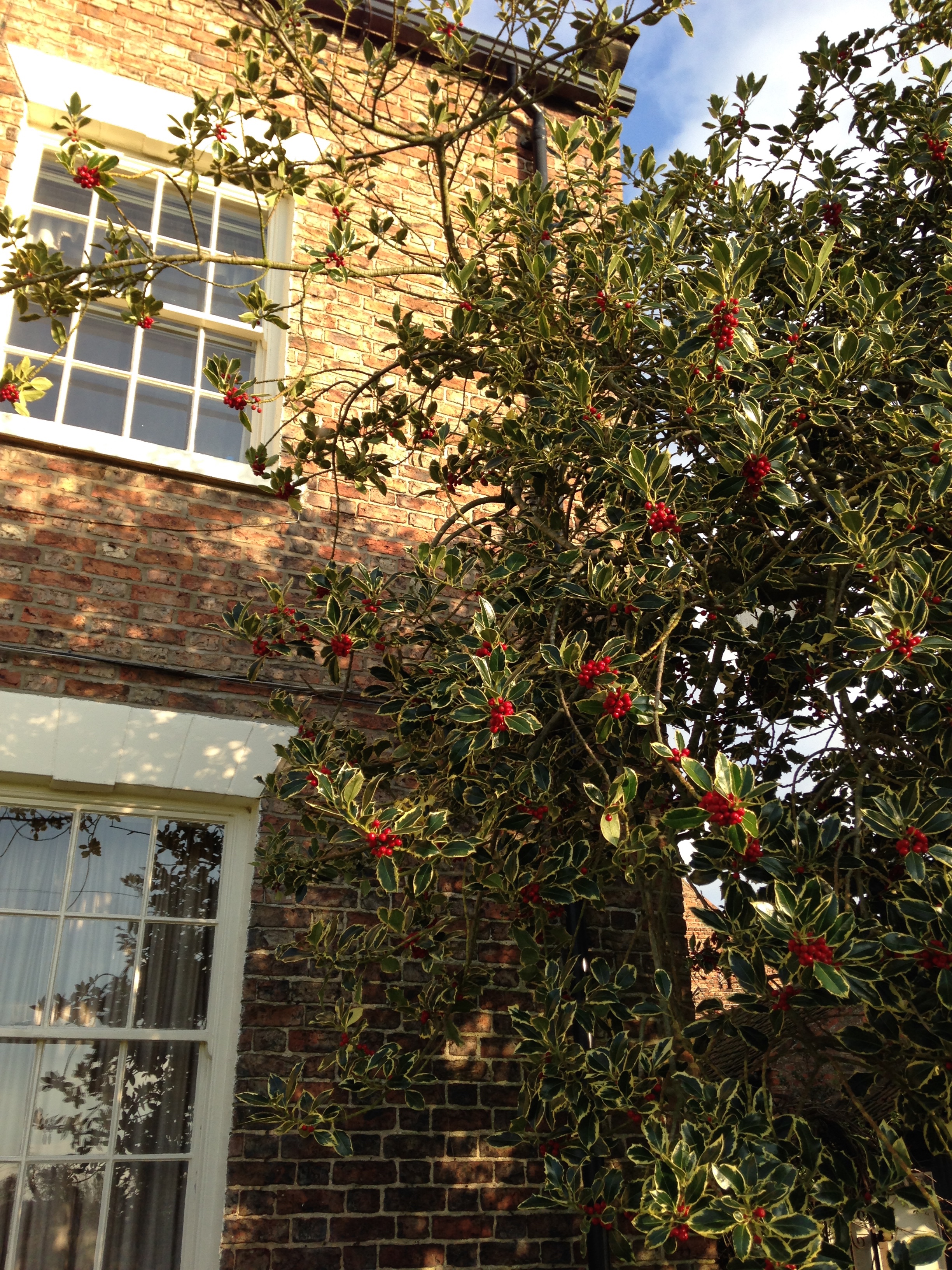
England isn’t any brighter than Ontario in November. The weather forecast predicts shades of grey—dark grey this morning but middle grey this afternoon, light grey tomorrow with a chance of sunny periods. But it is considerably warmer and much greener with the holly and the ivy at their best. The temperatures remained above freezing while we were there, some days reaching a high of eight degrees. And it was dry. Mostly.
But we didn’t go for the weather. We went to visit with our friends Mick and Jenny in their snug little house just outside the village of Howden. Jenny is the best cook I know, and every night (except when we ate at the pub) we sat down to a delicious meal. Risotto with ham and peas, a casserole of parsnips and carrots and I know not what (celeriac?) topped with creamy mashed potatoes, a full Christmas dinner one night, complete with roast goose and plum pudding. If that’s not a cure for November, I don’t know what is.
As often as we could, we walked into Howden and wandered up and down the narrow streets and around the old church and graveyard (“mooching around,” Jenny calls it). Th e original church in Howden dates back to the eighth century. It housed the tomb of St. Osana, who was made a saint for severely disciplining the concubine of a local priest… from beyond the grave. The poor woman inadvertently sat on the saint’s grave and was held fast until she repented (for being a concubine, I assume—not for sitting on a grave). But not before her clothes were ripped from her by hands unseen and she was beaten until she bled. I was careful about where I walked and did not sit down anywhere. You never know what will set a dead saint off.
That first church was rebuilt in the thirteenth century in grand Gothic style. An aisled choir building with magnificent vaulted ceilings and an elaborate chapter house were added later and somehow escaped demolition during Henry VIII’s Dissolution of the Monasteries. But not long after, they were abandoned (suppressed, they call it) and in the mid-eighteenth century the roof of the choir collapsed, followed shortly by the roof of the chapter house.
But the Minster, as it’s called (whatever that means) has survived over the years, and is still an active parish church. The day we visited, volu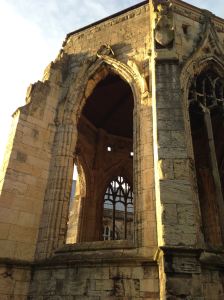 nteers were decorating it for a Christmas tea, setting up card tables and hanging things that looked like silver jellyfish from the chandeliers. We didn’t stay long. I found the ruins much more interesting than the damp, dim church. The sun, when it shines, picks out details that were never meant to see the full light of day, crumbling stone arches that once held up the roof, carved faces that once watched over meetings in the chapter house, now worn smooth by the weather. You get such a sense of the cold austerity, of the solemn dignity of the place. No folding chairs or tinsel in sight.
That’s the thing about England: its long history is always just under the surface, if you look. Our first day there, Mick and Jenny took us to see her brother’s new place in the village of Flaxton. It’s a three-storey house built in the eighteenth century, very grand from the street. But inside, you have to peel away the layers of paint and wallpaper and flooring to get a sense of the house that was. And will be again.
As her brother showed us from room to room, we admired the architectural features that had remained intact—the grand central staircase, huge wooden shutters on the floor-to-ceiling bay windows in the front rooms, the original coat pegs in a shallow cupboard beside a fireplace. The house has seven bedrooms in all, and a back hallway big enough to comfortably hold our boat (with the mast down). I could write in one room, read in another, cook in either the summer kitchen or the main kitchen. We could sleep in one bedroom, nap in another. Bica could have her own room. And we’d still have many rooms left over.
Which makes the boat feel very small, now that we’re back. It’s light grey outside today, snowing hard. But I’ve bought myself a big bouquet of flowers for the table and we’ve put up our Christmas decorations (no, no tinsel jellyfish, just a garland strung around the cabin). It’s very cosy in here now. And our job list looks like a postcard compared to the list of things to be done in the grand house.
Shore leave did me a lot of good. I’m glad to be home.
 We are in the marina at Port Credit for the winter, sheltered from the prevailing west wind by an old terminal building, a wide sturdy dock beside us. Well, sturdy-ish. The docks here sometimes come unmoored, drifting away from shore, or worse, sink altogether during the course of the the winter. But so far ours has stayed attached and afloat, touch wood.
 Liveaboard